
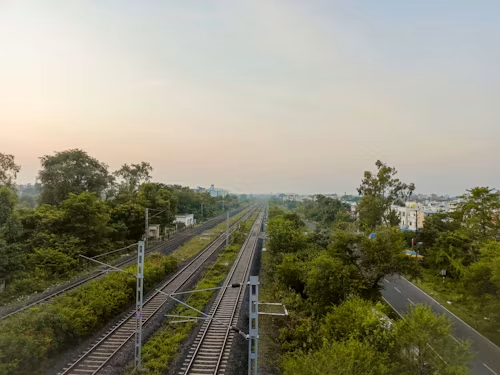
I had spent two days in Chennai before I boarded a local train. Until then, I had been travelling in an app cab, and to me, Chennai was just a set of road jams connected by elevated roads. The train changed all of that. In forty minutes, I figured out the lay of the land, where people live, and why so many people leave home early.
Chennai stretches along the Bay of Bengal in a long, flat line. Roads run in from the coast, and the suburban railway runs through the middle. If you want to see Chennai as residents do, this is the way.
Boarding at Chennai Beach
I boarded the train at Chennai Beach station, which is the terminal of this suburban rail service. It is close to Fort St George and the oldest trade routes of Parry’s Corner. The station is basic and a bit old, but clear enough. The platforms have numbers and signs in Tamil and English.
I got a ticket at the ticket counter. An application called UTS can also be used to buy a ticket if registered. Since I did not have the app, I waited in a small line and asked the person ahead of me about the railway platform.
The coach was busy but not overly crowded. Mid-morning is a good time to try your first ride. The early office rush is over, and you can usually find a seat or at least a good spot near the door.
The view from the Chennai line
The line from Beach toward Tambaram passes through Egmore, Mambalam and Guindy. Each stretch shows a different side of Chennai. Near Egmore, old government buildings and school grounds sit close to the tracks. Around Mambalam, the carriages empty and fill again as shoppers get off for T Nagar, one of the city’s busiest retail districts.
Farther down, Guindy has a completely different vibe. Trees show up, and the city opens up a bit. Guindy National Park lies near the station, a unique patch of shrub forest in a big city. I was not expecting to see this from the train, and it changed my thinking of the city.
Understanding Chennai by its stations
A station name often tells you what the surrounding area is for. Egmore is a major rail terminus with museums and a bus stand nearby. Mambalam is a market district. Guindy is an industrial and institutional hub. Tambaram is a residential suburb where many people live and commute.
When I started reading the city, I did not need a map that much. I could predict the connection between a neighbourhood and daily life. This was the main change. Chennai turned from being a bunch of attractions to a connected city where everything was logical.
Practical notes for riding in Chennai
Some points are worth knowing before you go. Women’s coaches are available on most suburban trains, and they are clearly marked. Station announcements are usually in Tamil, so watch the platform boards and ask a fellow passenger if unsure. Carry a small bag, since the coaches are not wide.
It is better to avoid rush hours between 8 and 10 am and 5 to 7 pm if it is your first visit. Even though the rail system works well, it is known for its crowds. Instead, take the MRTS line between Beach and Velachery, which is above ground. Moreover, it has beautiful views.
Choosing hotels in Chennai near a station
After that ride, I would choose hotels in Chennai with the railway in mind. Egmore is a practical base because it has long-distance trains, suburban connections and a short drive to Marina Beach. Hotels in Chennai near Mylapore suit those who want temples, old lanes and quick access to the MRTS. T Nagar works for shoppers, and the Mambalam station is close by.
A hotel near a station saves hours across a trip. It also gives you the option of skipping traffic whenever you want.
Chennai after the train
I must admit I did take some cabs afterwards, especially late at night. However, I stopped perceiving the city merely as a transit point. Travelling by the railway system gives this uniqueness that is totally different from travelling by other means.

 Michael Caine